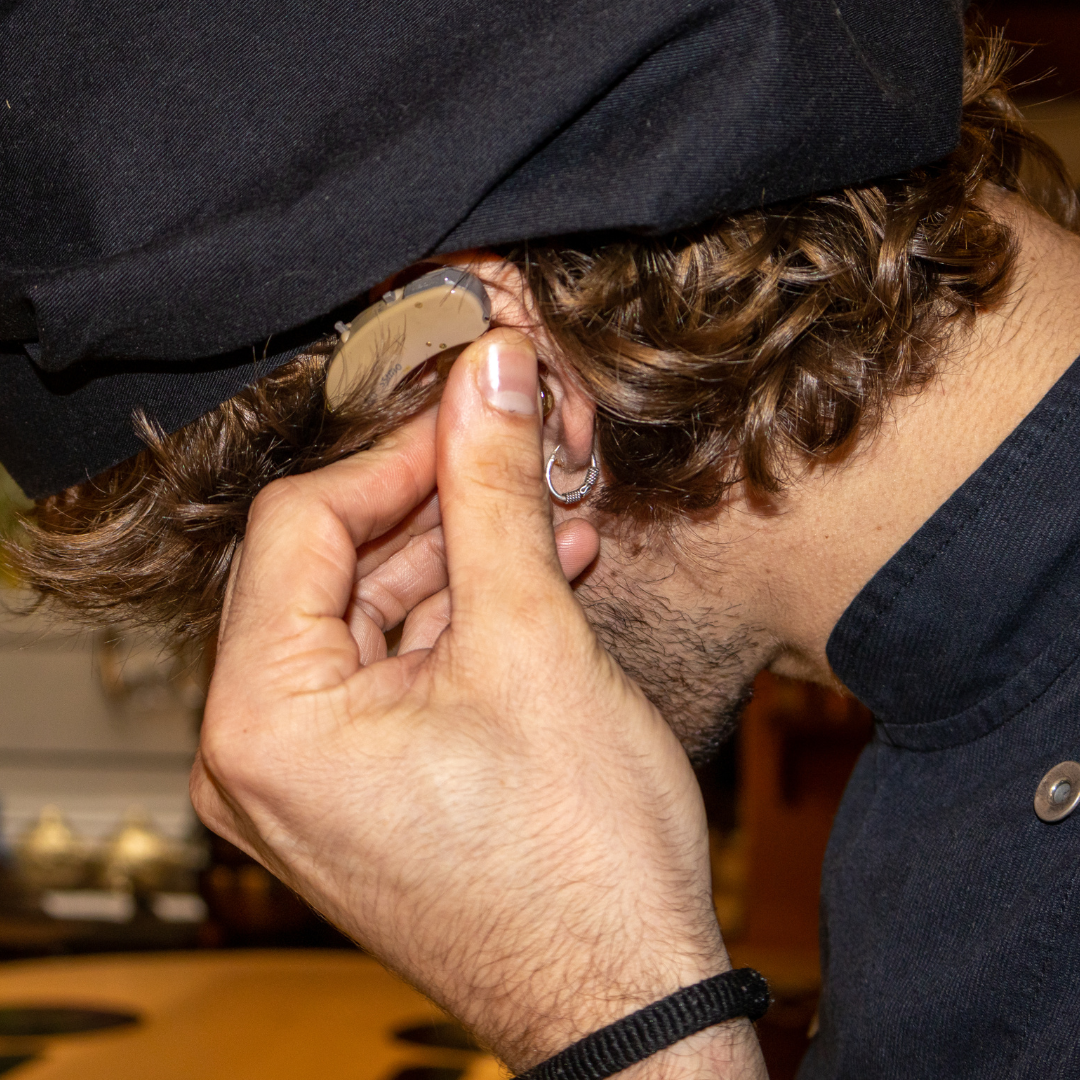
Active restaurant conversations are frequently hard to decipher when surrounding background noise clashes with your hearing. Our audiology clinic conducts specialized testing to evaluate hearing in both quiet sound booths and noisy simulations to isolate the underlying cause. Once we determine the cause of difficult hearing, we can help you find personalized solutions.
Understanding the Contrast Between Quiet Hearing and Restaurant Noise
Low-noise environments yield an advantageous signal-to-noise ratio where primary speech remains significantly louder than background sound. Dining venues establish an entirely contrary auditory challenge. Overlapping chatter, piped music, kitchen clatter, and hard-surface reverberation mask speech, forcing the brain to expend immense cognitive effort to track conversation.
Such listening challenges typically stem from high-frequency hearing loss, auditory-processing deficits, or accumulated noise-induced trauma. Visual limitations from low lighting, cognitive fatigue, and sitting farther away from conversational partners amplify speech degradation. Some patients pass standard pure-tone evaluations with normal scores yet exhibit substantial impairment during specialized speech-in-noise testing. Experiencing speech-recognition struggles in noisy dining venues warrants a formal audiological evaluation regardless of seemingly normal quiet hearing.
How Audiologists Identify High-Frequency Hearing Loss
Our diagnostic process starts with a detailed case history reviewing problematic listening scenarios, occupational noise exposure, tinnitus, ototoxic medications, and familial genetics.
Through pure-tone audiometry, we determine your faintest auditory perception across low to high pitches utilizing both air and bone conduction testing. Patients with high-frequency hearing loss typically exhibit a sloping audiogram configuration where sensitivity steadily declines at elevated pitches. Additional testing may include tympanometry to assess middle-ear function and word-recognition testing to measure speech understanding.
Since sound-treated booths cannot replicate the chaos of a crowded dining room, speech-in-noise testing provides critical real-world insight. The test assesses word and sentence discrimination as background acoustic competition intensifies. Collectively, these evaluations clarify if your challenges relate to raw audibility, phonetic clarity, signal-to-noise processing, or compound factors.
How Auditory Processing Difficulties Impact Adult Hearing
An auditory processing disorder affects how the central auditory nervous system interprets sound. The physical ear mechanisms may capture tones correctly, but the central brain pathways struggle to filter competing inputs, parse similar consonants, or interpret rapid speech. We first evaluate peripheral hearing and then determine whether an individualized auditory-processing test battery or referrals to other professionals are appropriate.
Practical Strategies for Improving Speech Understanding in Noise
Simple situational adjustments enhance the speech signal entering your ears and offer clearer facial cues. Before leaving home, identify quieter dining venues or plan to eat during less crowded service times. Venues with booths, acoustic panels, curtains, carpeting, and other sound-absorbing features may be easier than open rooms filled with hard surfaces.
While seated at the restaurant:
- Request table placement positioned away from dishwashing stations, bustling bars, sound speakers, and celebratory gatherings.
- Sit with your back near a wall to reduce noise coming from behind you.
- Position yourself to directly face companions under bright lighting to enhance facial comprehension.
- Reduce physical spacing between yourself and companions to maximize direct speech perception.
- Place your better-hearing ear toward the person you most want to hear.
- Encourage speakers to rephrase key information rather than simply repeating unparsed words louder.
- Confirm important details rather than pretending to understand.
- Excuse yourself for a momentary quiet pause when listening exhaustion starts to mount.
- Request that dining partners articulate words distinctly at an unhurried, natural speed.
- Shouting creates acoustic distortion that actively compromises speech understanding rather than helping.
Advanced Technology for Hearing in Background Noise
Selecting the ideal assistive technology depends upon underlying diagnosis, specific acoustic challenges, and verified hearing loss. Prescription hearing aids fitted by an audiologist leverage directional microphone arrays, advanced digital noise reduction, and dedicated restaurant programs to focus on frontal speech while dampening background sound. Maintaining realistic expectations remains essential, as no auditory device can isolate conversation by removing all surrounding voices.
A remote microphone can provide a stronger improvement in the signal-to-noise ratio. Positioned near or clipped to the speaker, the device transmits raw speech audio directly to paired hearing aids or external listening receivers. This targeted setup effectively neutralizes the negative impacts of room distance and interfering background noise.
Other clinically valuable tools include:
- Table microphones for small-group conversations
- Integrated telecoil programs for tapping into venue-wide induction loop systems
- Mobile speech-to-text applications delivering instant visual captions during dinner
- Over-the-counter hearables equipped with directional speech-enhancement algorithms
- Sound-level or restaurant-review tools for finding quieter locations
We will help compare available technology, verify device compatibility, and instruct you on utilizing your selected hearing equipment.
The Clinical Role of Audiologists in Managing Loud Environments
A comprehensive hearing evaluation looks far beyond the common misconception of “I hear fine in quiet environments.” Our clinicians review the specific environments, vocal pitches, and decibel levels that trigger breakdowns to design a personalized test protocol. The diagnostic battery may encompass pure-tone thresholds, acoustic middle-ear evaluations, suprathreshold word recognition, and speech-in-noise measures. Central auditory-processing testing is considered whenever clinical intake and initial test outcomes point toward higher-order deficits.
Rapidly progressing, asymmetrical, or sudden hearing decline warrants an urgent clinical referral to an ear, nose, and throat physician. Comprehensive clinical care targets the physiological roots of hearing difficulties rather than simply writing them off as bad restaurant acoustics.
Contact Us for a Hearing Evaluation Today
If dining in loud spaces leaves you feeling isolated, fatigued, or guessing at missed speech, contact us to schedule a thorough hearing evaluation. We provide proven treatments to enhance your hearing in noisy environments, offering hearing aid fine-tuning, specialized assistive accessories, and individualized auditory therapy.
Contact us to request an appointment and take the next step toward easier conversations.