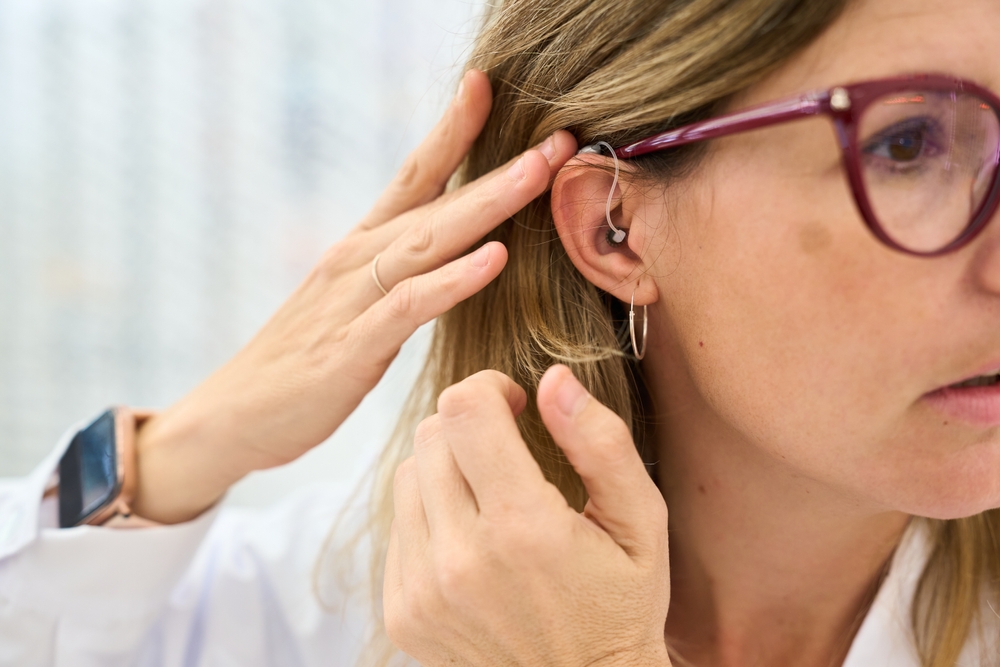
Many people delay getting hearing aids because they don’t think they’ll like how they look or feel. In past generations, primitive auditory devices were heavy, highly visible, and frequently viewed as an embarrassing marker of advanced age. Regrettably, some people even experienced social alienation because acquaintances falsely assumed that wearing a visible aid signaled a complete inability to comprehend spoken dialogue.
Because this archaic mental image endures, thousands remain deeply reluctant to schedule an initial audiometric evaluation. But the reality is that today’s modern hearing aids look and feel very different from what you might expect. Revolutionary breakthroughs in micro-component miniaturization and ergonomic design have rendered these devices incredibly compact, ultra-lightweight, and virtually unnoticeable.
Should your reluctance stem entirely from memories of obsolete, bulky hardware, you owe it to yourself to discover current medical advancements.
Why the Bulky, Obvious Hearing Aid Is a Thing of the Past
When most individuals conjure an image of assistive listening technology, they envision a massive beige plastic chassis hooked over the pinna and obvious to everyone nearby. If that’s the case, you’re thinking about hearing aids circa the 1980s and ’90s.
Since then, the entire category has evolved. Continuous refinements in ergonomic styling, nanometer-scale circuitry, and digital audio engineering have radically overhauled the modern cosmetic profile. Today’s instruments are profoundly smaller, remarkably streamlined, and strategically engineered to blend flawlessly into your natural anatomy or vanish altogether.
Numerous modern instruments are inserted completely within the ear canal structure, rendering them undetectable throughout standard daily dialogue. Others rest behind the ear but are so compact and lightweight that they’re easy to overlook, especially when matched to your hair or skin tone.
Understanding Your Options: A Guide to Contemporary Device Form Factors
To understand how these sophisticated medical devices are physically configured, review this concise anatomical breakdown:
Invisible-in-canal (IIC)
This tier represents the absolute pinnacle of cosmetic concealment. IIC devices sit completely inside the ear canal and are custom-made to fit your ear. During typical face-to-face communication, these custom models remain completely obscured from view. They remain an exceptionally sought-after solution for patients with mild-to-moderate deficits who refuse to compromise on cosmetic privacy.
Modern Standards: Receiver-in-Canal (RIC) / Receiver-in-the-Ear (RITE)
This particular layout has become the benchmark standard for contemporary hearing health restoration. A microscopic electronic hub is positioned behind the outer ear, anchored by an ultra-thin, transparent lead to a high-fidelity speaker seated inside the canal. At a glance, they often resemble wireless earbuds. Most people won’t notice them unless they’re looking.
Traditional Behind-the-Ear (BTE) Reimagined
These units reside entirely behind the external ear, providing a slightly larger chassis that is still infinitely more elegant than historical variations. They are typically prescribed to resolve advanced levels of hearing impairment, generating exceptional sound amplification without the cumbersome weight users traditionally dread.
The fundamental lesson is clear: current acoustic technology is engineered to integrate seamlessly into your personal lifestyle, never to advertise an impairment.
How Current Hearing Technology Outperforms Traditional Amplifiers
It is vital to recognize that this technological revolution is not simply a visual upgrade. Today, they function more like smart devices than traditional medical equipment. Most current systems boast universal wireless syncing, channeling smartphone calls, high-definition music, and television broadcasts directly to your internal receivers.
Equipped with dedicated smartphone applications, they allow users to manipulate volume matrices or toggle environmental programs without making manual physical adjustments. If you enter a chaotic, crowded room, you can optimize your digital noise reduction settings to isolate speech within seconds. Furthermore, lithium-ion rechargeable cells have entirely eliminated the need to fiddle with microscopic, short-lived zinc-air batteries. Just place them on a charger overnight, like your phone.
Getting Over the Fear and Stigma of Hearing Devices
Even with this encouraging information, taking the initial step toward treatment can induce anxiety. Acknowledging a sensory deficit and investigating rehabilitation options often forces a difficult confrontation with our own vulnerability and bodily changes. This mental hurdle can make an individual feel exposed, creating a false impression of losing authority over personal wellness.
However, an alternative, empowering framework exists: utilizing hearing technology is never an indicator of structural failure. They’re simply a sign of change, which happens to us all. They’re proof that you’re taking action to support and equip your body in essential ways.
Picture yourself wearing an ultra-low-profile, virtually invisible instrument that allows you to effortlessly decode rapid speech, thrive in complex soundscapes, and re-engage with your favorite hobbies. Talk about empowering!
See For Yourself What Today’s Hearing Aids Look Like
The easiest way to let go of that outdated mental image is to check out for yourself what’s available. Our clinical team cordially invites you to visit our facility, interview our staff, and evaluate different form factors in a stress-free, zero-obligation environment. Treat this as a risk-free exploratory step to comprehend the incredible aesthetic shift that has occurred in our field.
Most people leave surprised by how small, comfortable, and natural modern hearing aids have become! Do not let outdated myths delay your wellness—call our specialized practice or book your appointment online today.